


Information and Media Outreach Cell
IIT Kanpur

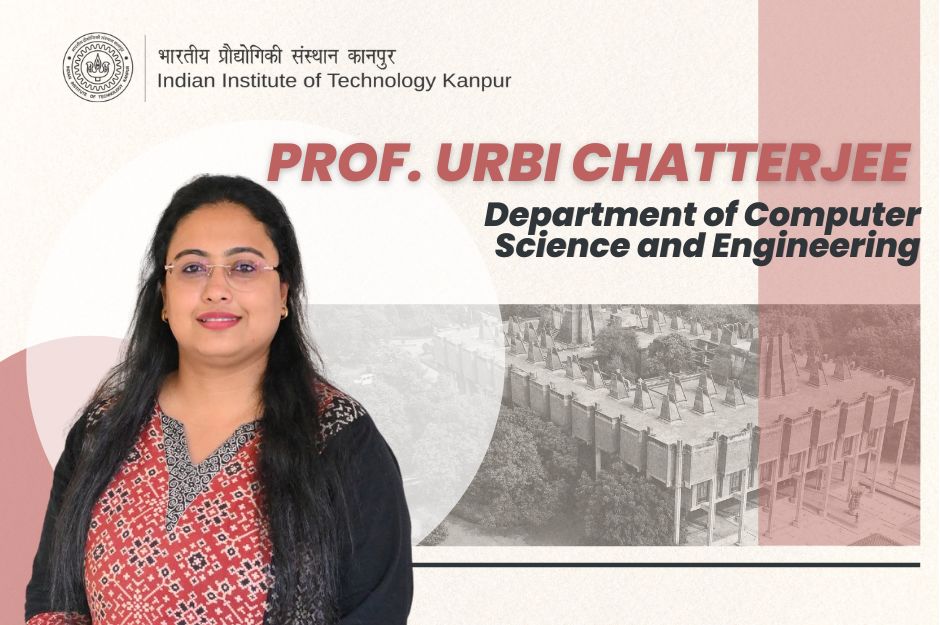
Engineering a Future Beyond Gender Barriers: Prof. Urbi Chatterjee
Computer Science & Engineering
The quote “Every girl, no matter where she lives, deserves the opportunity to develop the promise inside of her” by Michelle Obama; is more than just a line on her social media handle. For Prof. Urbi Chatterjee, that promise began to take shape early in life. It reflects a belief that has quietly shaped her journey.
Growing up in Kulti, a modest township in West Bengal, and educated in a Bengali-medium school, her early years were rooted in simplicity but driven by curiosity. Born into a family of academicians, her father a school teacher learning came naturally, almost as an inheritance. Her fascination with computers began early, setting the foundation for what would become a deeply focused academic path.
Prof. Chatterjee’s journey, however, was not without its setbacks. Without the benefit of formal coaching, she did not clear the IIT-JEE examination. But she chose not to see this as failure. “It was not a setback, it was a learning experience,” she reflects.
She went on to pursue engineering at a private college in Asansol. From the second semester onward, her focus sharpened towards the GATE examination. Her determination paid off when she secured admission to the M.Tech program at IIT Dhanbad, an achievement that strengthened her confidence and clarified her direction.
After completing her M.Tech, she joined Tata Consultancy Services (TCS). Yet, despite a promising start in the corporate world, she felt something was missing. “I had a strong desire to own every intellectual property I create,” she says. That realization brought her back to academia, leading her to pursue a PhD at IIT Kharagpur.
At a stage when many aspire to move abroad, she chose to stay back, respecting her family’s wishes. Her doctoral research focused on the Internet of Things (IoT), a rapidly evolving field enabling interconnected systems of smart devices capable of sensing, communicating, and acting in real time.
Prof. Chatterjee’s work contributed significantly to secure communication in IoT networks. She developed an identity-based authentication and key-generation protocol using Physically Unclonable Functions (PUFs), a cutting-edge hardware security primitive. By generating unique hardware identities for devices, her research enabled secure and efficient communication across IoT systems.
Following her doctorate, she was selected for a postdoctoral position at New York University. However, the COVID-19 pandemic disrupted these plans, halting her move abroad. Rather than allowing this to deter her, she redirected her efforts and joined IIT Kanpur in 2021, continuing her academic journey with renewed clarity.
Building a Strong Foundation
She believes that the rapid expansion of AI-driven, IoT-enabled, and resource-constrained systems has made hardware security and reliability critical engineering priorities. “Vulnerabilities at the hardware level directly compromise system correctness, data integrity, and trust,” she explains.
Her research group, working with national and international collaborators, has made impactful contributions across key domains. In approximate computing for AI/ML workloads, the team has developed energy-efficient hardware techniques for edge systems, including soft-error-resilient representations for both integer and floating-point data. Their work on dual-mode rounding hardware for Posit-based deep neural networks has improved efficiency without compromising accuracy.
The group has also contributed to hybrid probabilistic–statistical error metrics for approximate adders, explored hardware Trojan design in approximate circuits, and developed SAT-based methodologies for detecting malicious activations. Together, these efforts lay a strong foundation for designing secure, efficient, and scalable hardware systems for next-generation applications.
Beyond the Lab
Away from research, she finds expression in music, particularly Rabindra Sangeet, and is part of a campus group that meets regularly to practice. She also has a deep appreciation for India’s handloom heritage, often collecting sarees from the places she visits.
A book that has significantly influenced her thinking is Think and Grow Rich by Napoleon Hill, which she regards as a guiding force in shaping her mindset and ambitions.
Reflecting on her Bengali-medium education, she acknowledges that communication in English was initially a challenge. “Technically, I knew I was strong, but I had to work on expressing myself better,” she says.
Her approach was methodical, she would read English newspapers aloud, record herself, and compare her recordings with those of professional news anchors. Over time, this disciplined practice helped her gain confidence and fluency.
Prof. Urbi’s journey is not defined by where she began, but by how consistently she chose to move forward, turning limitations into learning and learning into a lasting impact.