


Information and Media Outreach Cell
IIT Kanpur

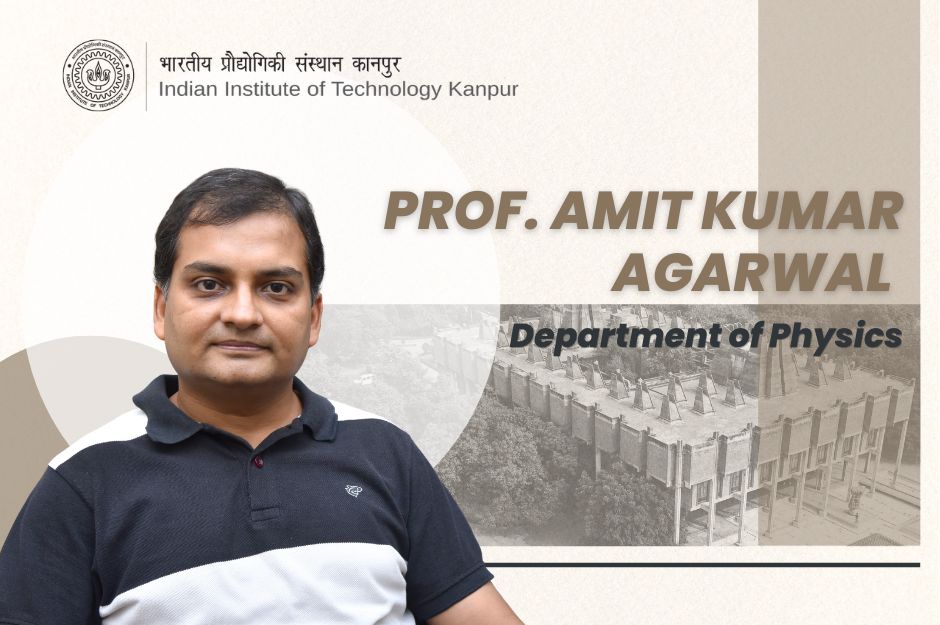
From Uncertainty to Quantum Insight: The Journey of Prof. Amit Agarwal
Physics
Prof. Amit Agarwal is a theoretical physicist working at the interface of quantum transport, many-body physics, and quantum materials. Currently a professor at Indian Institute of Technology, Kanpur and a recipient of the 2025 Shanti Swarup Bhatnagar Prize, his work focuses on uncovering fundamental phenomena in quantum materials and topological systems, often with an eye toward experimental relevance.
His journey into theoretical physics was not predictable. Growing up in Chirkunda, near Dhanbad, he describes himself as an average student until about Class 7. Over time, a sense of academic curiosity began to emerge, driven more by a determination to forge a path different from his family's business than a natural inclination toward academics.
By Class 12, Prof. Agarwal knew he wanted to pursue something technical and mathematical, though physics had not yet become a clear calling. After an unsuccessful attempt at the IIT-JEE, he enrolled at Kirori Mal College, University of Delhi, to pursue a B. Sc. (Hons) in Physics. Even then, he was seriously considering shifting to computer applications.
Finding Direction in Physics
Clarity came when he cleared the exam and joined the integrated PhD programme at the Indian Institute of Science (IISc), Bengaluru. Here, his intellectual engagement deepened and his interests crystallised around theoretical condensed matter physics, particularly quantum transport and many-body phenomena in low-dimensional systems. Under the motivating guidance of Prof. Diptiman Sen, his doctoral work explored transport in Luttinger liquids, quantum wires, quantum Hall edge states, and quantum charge pumping. His thesis, Transport Properties of Quasi-One-Dimensional Quantum Systems, earned him the Kumari L. A. Meera Memorial Medal for the best PhD thesis in theoretical physics and Mathematics (2009–2011).
Following his PhD, Prof. Agarwal moved to Italy as a Marie Curie Postdoctoral Researcher at the Scuola Normale Superiore, Pisa, where he worked with Prof. Rosario Fazio and Dr. Marco Polini. His research expanded into two-dimensional electron systems, focusing on quantum many-body effects and collective excitations in systems with strong spin–orbit coupling. This marked a transition from one-dimensional to two-dimensional systems. His broader interests also extended to ultracold atoms, graphene, and topological insulators.
Expanding Horizons
After three intensive years in Pisa, Prof. Agarwal returned to India in 2012 to join the Indian Institute of Technology, Kanpur. He refers to the institute as his karambhoomi, a place that offered him a new beginning and helped him evolve as a researcher and an educator. “This is the place that shaped me as an independent academic,” he reflects. “ wanted to give my best, so I pushed myself and build everything from the ground up, my research program, my teaching style, and how I choose and approach problems. There were some initial mistakes, but they are a part of the process of getting it right.”
At IIT Kanpur, Prof. Agarwal has taken an interdisciplinary approach, collaborating with engineering departments and connecting fundamental theory with experimental platforms. His current research focuses on quantum transport and band-geometry-driven phenomena in quantum materials, with increasing emphasis on making experimentally testable predictions with real-world relevance.
In recognition of his contributions, he was awarded the 2025 Rashtriya Vigyan Puraskar: Vigyan Yuva – Shanti Swarup Bhatnagar Prize, one of Indias highest honours in science and technology. Reflecting on his journey, Prof. Agarwal notes that while he continues to value the elegance of theoretical work, he is increasingly motivated to ensure that his research connects meaningfully with experiments and applications.
Beyond academia, his interests remain simple. “I like to play chess sometimes,” he says. “My life largely revolves around family, research, and I immensely enjoy teaching. These are where my focus is.”