


Information and Media Outreach Cell
IIT Kanpur

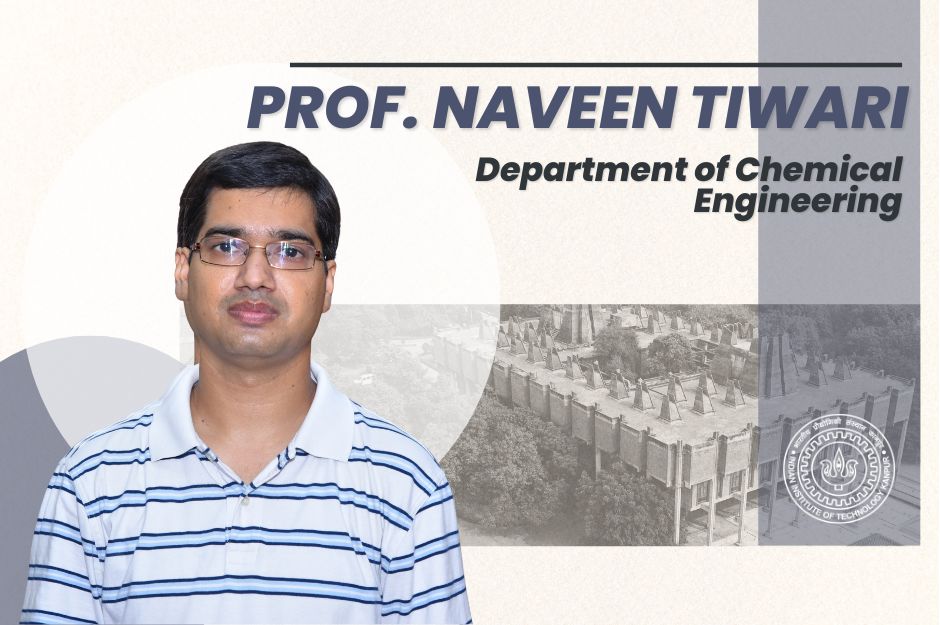
From IIT Campuses to Frontiers in Fluid Mechanics: Prof. Naveen Tiwari's Journey
Chemical Engineering
A journey shaped by mathematics, modelling, industry research, and a continuing quest to understand complex fluid systems.
Prof. Naveen Tiwari grew up in the intellectually vibrant environment of Indian Institute of Technology Delhi, where his father worked as a staff member. Surrounded by an atmosphere of scholars, research discussions, and the early stirrings of computational modelling, he absorbed the rhythms of academic life from a young age. Yet, despite this environment, engineering was not an early aspiration.
His childhood was shaped as much by the playground as by books. Cricket, badminton, and reading filled his free hours. Academically, mathematics came naturally to him, while physics was not a particular favourite and chemistry felt largely like rote learning. Ironically, his Class XII board examination results told a different story, he scored highly in physics, while his mathematics marks were less satisfactory. Accepting these unexpected results became an early lesson in adapting to life’s turns.
Although he had heard about the Joint Entrance Examination (JEE) after Class X, the idea of pursuing engineering remained somewhat vague. Nevertheless, he appeared for the examination without the intense coaching that had already become common among aspirants. In a process he describes as unfolding almost organically, he successfully cleared the examination.
With his parents keen that he remain within a familiar academic environment, he joined Indian Institute of Technology Delhi to pursue a B.Tech in Chemical Engineering. The subject initially presented challenges. The first two years were marked by academic anxiety and adjustment. However, by the third semester he began to develop a genuine intellectual engagement with the discipline. At that stage, however, a career in research had not yet taken shape in his mind, his interest leaned more toward applying his skills in industry.
After completing his undergraduate degree, he eventually secured admission for doctoral studies at the University of Massachusetts Amherst in 2003, after missing earlier application deadlines. The five years he spent there proved transformative, both academically and personally.
Prof. Tiwari’s doctoral research focused on the theoretical and numerical modelling of thin liquid films. The work explored the motion and stability of liquid films flowing over heated surfaces, an area with important applications in coating technologies and heat-transfer systems. The study examined how temperature gradients create variations in surface tension, generating Marangoni stresses that influence fluid flow and lead to distinctive ridge formations at the gas–liquid interface. The research also contributed to a broader understanding of microscale and nanoscale flows over surfaces with variations in chemistry, temperature, and topography.
What particularly drew him to this work was its deep connection with mathematics and modelling. “This excited me because it was fundamentally woven around mathematics,” he recalls.
Life during his doctoral years extended well beyond the laboratory. He explored new interests like learning to play the guitar, hiking in the surrounding landscapes, and participating in theatre. These experiences broadened his outlook and balanced the rigours of research.
After completing his PhD, Prof. Tiwari joined the R&D centre of Saint-Gobain in Northborough, Massachusetts, where he worked as a Senior Research Engineer until November 2012. In this role, he led numerical modelling efforts in several advanced materials and energy systems, including solid oxide fuel cells (SOFCs), sapphire crystal growth processes, and other high-temperature ceramic technologies. His work resulted in multiple invention disclosures and provided valuable experience in industry-driven research.
“It was an excellent learning experience,” he notes. “It taught me how to work within strict timelines and translate theoretical understanding into practical solutions.”
During his years at Saint-Gobain, interactions with researchers such as Martin Z. Bazant at Massachusetts Institute of Technology also helped deepen his appreciation for fundamental research and strengthened his motivation to pursue challenging problems in fluid mechanics and transport phenomena.
Family considerations eventually prompted his return to India. On December 12, 2012, an easily memorable date he jokingly recalls as 12.12.12; he joined the faculty at Indian Institute of Technology Kanpur as an Assistant Professor.
Since then, his research has centred on fluid mechanics and transport phenomena, with a particular emphasis on theoretical modelling and its industrial applications. He continues to collaborate with industry partners, applying fundamental scientific insights to solve practical engineering challenges.
Reflecting on a career that has moved between academia and industry before returning to academia, Prof. Tiwari sees the journey as a natural continuum. “The two worlds are deeply interconnected,” he says. “Each informs and strengthens the other.”
Despite the demands of academic life, he remains committed to the interests that shaped his childhood, sports, reading and maintaining a life beyond research continuing the balance that has defined his journey from campus beginnings to global scientific engagement.