


Information and Media Outreach Cell
IIT Kanpur

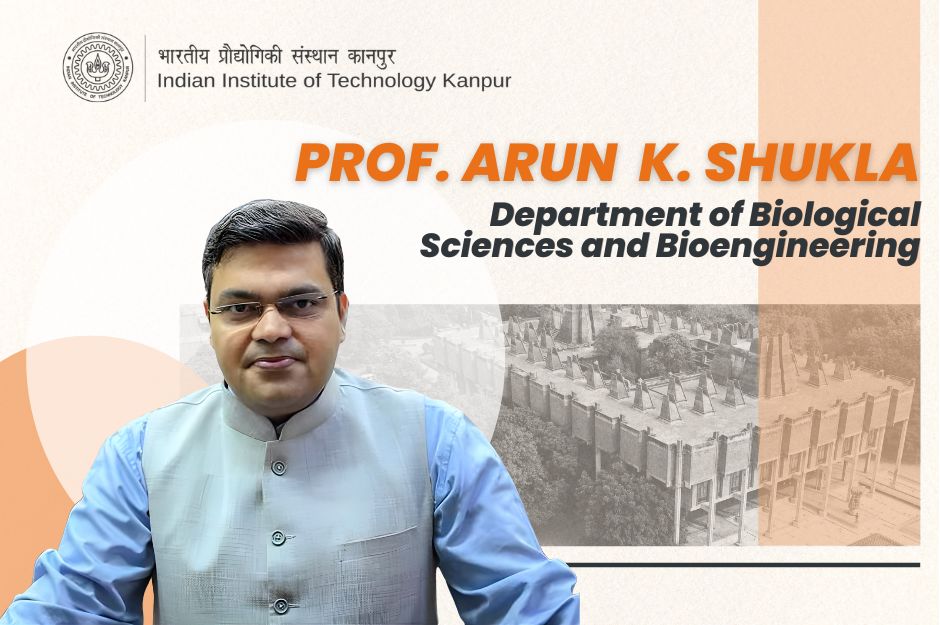
From three Nobel Mentors to the Frontiers of Next-Gen Drug Discovery: Prof. Arun Shukla's Journey
Biological Sciences & Bioengineering
He has been mentored by not one, but three Nobel laureates—and the most profound lesson he learned from them is that in science, one should always think big.
Prof. Arun K. Shukla’s career trajectory shifted completely because he was unable to sit for the premedical examination due to age-related eligibility criteria. This early setback transformed his path, leading him from being a medical aspirant to becoming one of the foremost scientists in the field of drug discovery. His transition into research, however, was anything but accidental.
Raised in an academically inclined family in Gorakhpur, Uttar Pradesh, Prof. Arun Shukla’s elder brother played a pivotal role in introducing him to the world of research. He completed his Bachelor’s degree in Biology from Gorakhpur University. By the time he finally met the age requirements for the medical entrance exam, he had already begun exploring a closely related field: biotechnology. Faced with a choice between the two, he opted for the latter and went on to pursue a Master’s degree in Biotechnology from Jawaharlal Nehru University (JNU).
While his father hoped he would use the JNU platform to prepare for the civil services, Prof. Shukla used his time there to hone his research acumen instead.
“This was a turning point. I stayed back during the summer break after the 1st year just to get a feel for working in the molecular biology labs. It was extremely exciting to visualize DNA and proteins on gel, and I realized that this was my true calling.”
Decoding GPCR
His research journey received a major boost when he joined the Max Planck Institute of Biophysics in Frankfurt for his doctoral program. His three-year doctoral research was conducted under the guidance of Nobel laureate Prof. Hartmut Michel, focusing on the biochemical characterization, purification, and structural biology of G protein-coupled receptors.
“My research attempted to peek into the atomic structure of GPCRs. I dived deeper into the area to understand their function and mechanism.”
He then pursued postdoctoral research at Duke University in collaboration with Stanford University, working under two more Nobel laureates: Prof. Robert Lefkowitz and Prof. Brian Kobilka, who shared the 2012 Nobel Prize in Chemistry for their groundbreaking studies on GPCRs.
Even after gaining such extensive global exposure, Prof. Shukla was certain about returning to India. His goal was to establish GPCR research in his home country—a field that was still in its nascent stage there.
“I had a dream to position India in the global arena of GPCR biology and drug discovery on membrane proteins. It was a daunting task, as there were limited resources and infrastructural hiccups. It was risky, time-consuming and plagued by a lack of visibility.”
Since joining Indian Institute of Technology, Kanpur in 2014, his team size has remained steady, averaging between 15 and 20 members.
Prof. Shukla recalls the early challenges of setting up his facility: “There was no cryo-electron microscope when we started. These machines are very expensive, but we were finally able to acquire one through funding from the Anusandhan National Research Foundation (ANRF).”
Current Research Horizons
When asked about the current focus of his research team, Prof. Shukla highlights their cutting-edge approach to therapeutics.
“We are trying to design drugs that have minimal or no side effects. We are also heavily focused on AI-guided de novo protein design.”
Maintaining that this research holds immense potential for drug discovery, he points out a massive knowledge gap: while the human body contains around a thousand different GPCRs, science has only mapped and understood about 150 of them.
“There is still so much more to uncover. Unlocking these new mechanisms will undoubtedly pave the way for novel drug innovations.”
A Lifelong Journey in Science
Reflecting on his entire journey—from a potential medical aspirant to a pioneering drug discovery researcher— Prof. Shukla views his career not as a detour, but as a destination.
“Research is a never-ending exploration of the unknowns, and for me, that’s the most exciting aspect.”